
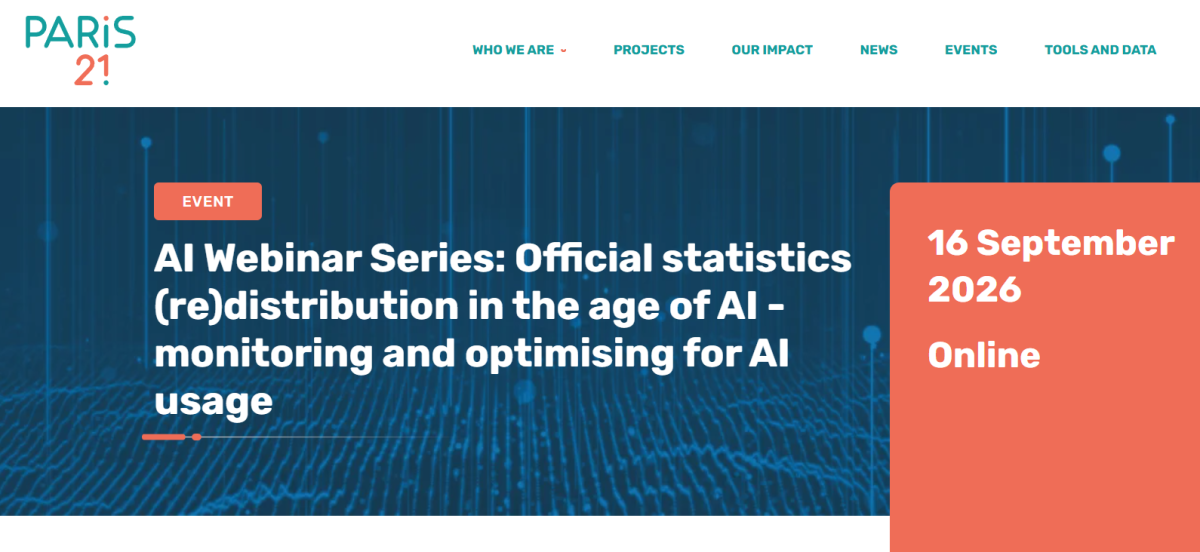
En un contexto global donde la Inteligencia Artificial transforma radicalmente el acceso a la información, la alianza internacional Paris21 llevó a cabo una nueva entrega de su ciclo AI Webinar Series, titulada Official statistics (re)distribution in the age of AI – monitoring and optimising for AI usage. El encuentro virtual reunió a líderes de oficinas de estadística, analistas de datos y formuladores de políticas públicas para discutir cómo los organismos oficiales deben adaptar sus ecosistemas de distribución ante la rápida adopción de modelos de IA.
Durante la jornada, los ponentes abordaron la creciente dependencia de los grandes modelos de lenguaje (LLM) y plataformas automatizadas sobre los datos públicos. Se enfatizó la urgencia de establecer mecanismos rigurosos de monitoreo que permitan evaluar cómo las herramientas de IA consumen, procesan y redistribuyen la información estadística, garantizando la calidad, integridad y atribución adecuada de la fuente original. Asimismo, se expusieron estrategias de optimización técnica para facilitar que estos sistemas de IA interpreten los datos de forma precisa, evitando sesgos y desinformación en las respuestas generadas a la ciudadanía.
Paris21 y Open Data Watch debaten la adaptación de la estadística oficial en la era de la IA con el soporte de GO BILINGUAL
El encuentro contó con una participación clave de Open Data Watch (ODW) a través de las bases presentadas en su análisis “Making Official Statistics Work in an AI-Driven World”. Durante la jornada se advirtió sobre un cambio estructural en el consumo de información: una proporción cada vez mayor de ciudadanos, periodistas y tomadores de decisiones ya no consulta directamente los portales estadísticos oficiales, sino que obtiene las cifras a través de asistentes virtuales y chats de IA.
Los ejes centrales del debate
- De la apertura a la preparación para la IA (AI Readiness): A partir de los hallazgos del Open Data Inventory (ODIN) de ODW, se destacó que la inversión realizada durante años en datos abiertos (formatos legibles por máquina, licenciamiento libre y estándares de metadatos) constituye hoy el cimiento esencial para que los sistemas de IA interpreten correctamente la información oficial.
- Monitoreo y precisión de las fuentes: Los expertos enfatizaron la urgencia de establecer protocolos para monitorear cómo las plataformas de IA rastrean, sintetizan y redistribuyen los datos públicos. Esto busca prevenir “alucinaciones” o interpretaciones erróneas que comprometan la veracidad de indicadores socioeconómicos críticos.
- Atribución y valor de los datos oficiales: Se subrayó la importancia de garantizar que las herramientas de IA reconozcan la autoría original de los organismos oficiales, preservando la confianza institucional y la calidad en la formulación de políticas públicas.
Comunicación global sin fronteras
Para asegurar una conversación inclusiva dada la diversidad regional de las organizaciones involucradas, la empresa especializada GO BILINGUAL tuvo a su cargo la facilitación lingüística del evento.
A través de un despliegue de interpretación e integración multilingüe en inglés, francés y español, GO BILINGUAL garantizó un intercambio fluido y en tiempo real entre los ponentes de Open Data Watch, representantes de Paris21 y asistentes internacionales. La intervención técnica permitió que las discusiones sobre gobernanza de datos y preparación tecnológica mantuvieran un alcance verdaderamente global, eliminando cualquier barrera idiomática en un debate estratégico para el futuro de la información pública.
Conoce más de:
MAKING OFFICIAL STATISTICS WORK IN AN AI-DRIVEN WORLD – Open Data Watch
inlook.ai – The visual search engine for official statistics
Open Data Inventory—Global Index of Open Data – Open Data Inventory
PARIS21 Explores the Impact of Artificial Intelligence on Official Statistics with the Support of GO BILINGUAL
In a global context where Artificial Intelligence is radically transforming access to information, the international partnership PARIS21 held a new installment of its AI Webinar Series, titled “Official statistics (re)distribution in the age of AI – monitoring and optimising for AI usage.” The virtual event brought together leaders from statistical offices, data analysts, and policymakers to discuss how official agencies must adapt their distribution ecosystems in light of the rapid adoption of AI models.
During the session, speakers addressed the growing reliance of large language models (LLMs) and automated platforms on public data. They emphasized the urgent need to establish rigorous monitoring mechanisms to evaluate how AI tools consume, process, and redistribute statistical information, ensuring the quality, integrity, and proper attribution of the original source. Likewise, technical optimization strategies were presented to help AI systems interpret data accurately, avoiding bias and misinformation in the responses generated for the public.
PARIS21 and Open Data Watch Discuss the Adaptation of Official Statistics in the AI Era Supported by GO BILINGUAL
The event featured key participation from Open Data Watch (ODW), drawing on insights from its analysis “Making Official Statistics Work in an AI-Driven World.” During the session, experts warned of a structural shift in information consumption: a growing proportion of citizens, journalists, and decision-makers no longer consult official statistical portals directly, but instead obtain figures through virtual assistants and AI chatbots.
Key Pillars of the Debate
- From Openness to AI Readiness: Building on findings from ODW’s Open Data Inventory (ODIN), speakers highlighted that years of investment in open data—machine-readable formats, open licensing, and metadata standards—now serve as the essential foundation for AI systems to correctly interpret official information.
- Monitoring and Source Accuracy: Experts stressed the urgency of establishing protocols to monitor how AI platforms crawl, synthesize, and redistribute public data. This aims to prevent “hallucinations” or misinterpretations that could compromise the accuracy of critical socioeconomic indicators.
- Attribution and Value of Official Data: Emphasized the importance of ensuring AI tools credit original official sources, preserving institutional trust and the quality of policymaking.
Global Communication Without Borders
To ensure an inclusive conversation given the regional diversity of the participating organizations, the specialized firm GO BILINGUAL was in charge of the event’s linguistic facilitation.
Through a deployment of multilingual interpretation and integration in English, French, and Spanish, GO BILINGUAL guaranteed a smooth, real-time exchange among Open Data Watch speakers, PARIS21 representatives, and international attendees. This technical support allowed discussions on data governance and technological readiness to maintain a truly global reach, removing language barriers from a strategic debate on the future of public information.